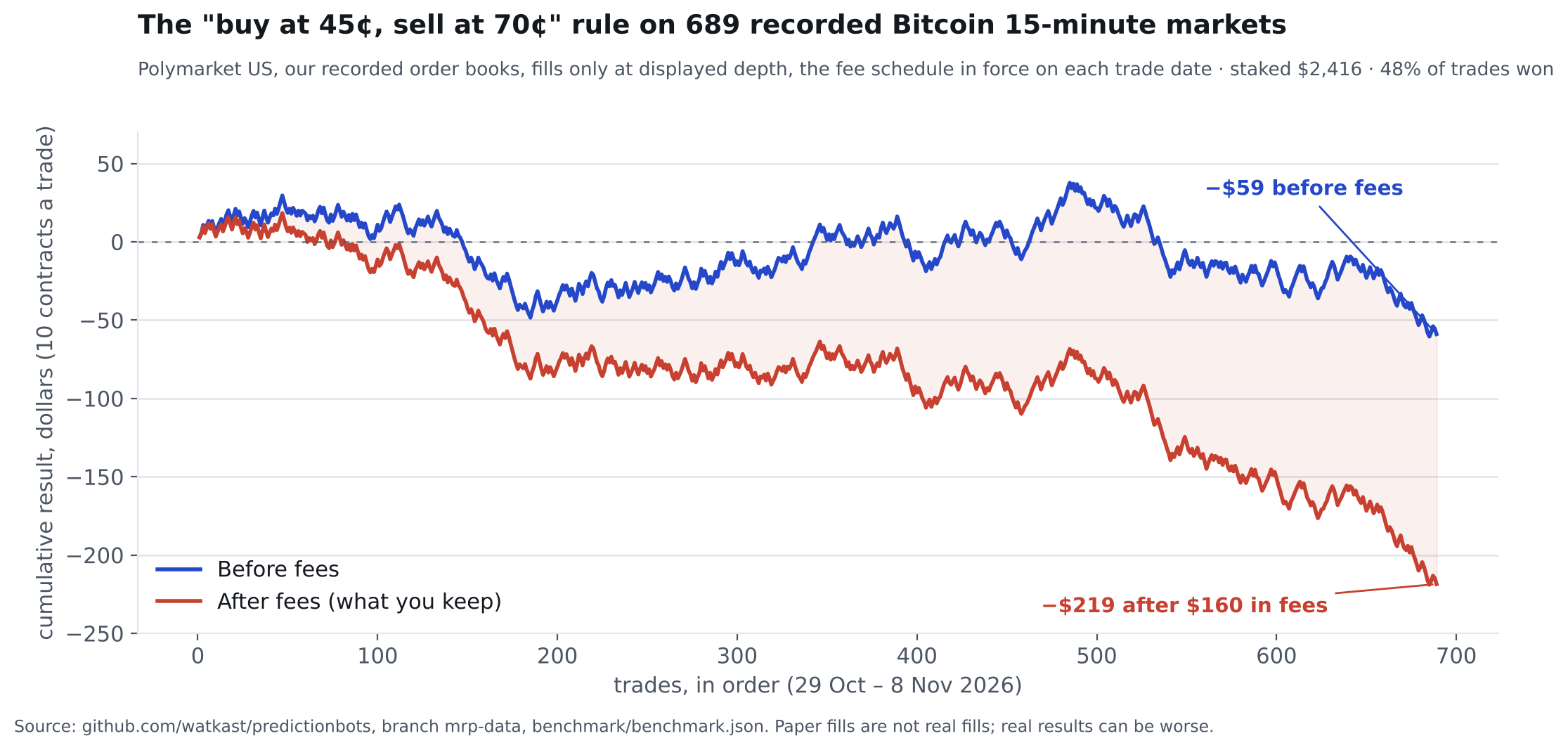
We ran the \"buy at 45¢, sell at 70¢\" rule on 689 recorded Bitcoin markets. It lost 9 cents on the dollar, and fees were three-quarters of the loss.
If you have read a tutorial or a vendor page about trading 15-minute Bitcoin markets, you have met this rule: buy a side when it is 45¢ or less, sell it when it reaches 70¢. It is the retail strategy of the category, quoted everywhere and tested nowhere we could find. So we tested it, the way the Bot Benchmark tests everything: the rule as published, our recorded order books, fills only where the book showed size, the real fee on the real date.
The numbers
| Measure | Value |
|---|---|
| Windows recorded (BTC 15-minute, Polymarket US, 29 Oct to 8 Nov 2026) | 745; 689 usable (settled, with at least half the window’s book on file) |
| Trades | 689 (the rule found a side at 45¢ or less in every usable window) |
| Winners | 48% |
| Staked | $2,416 (10 contracts a trade, or the displayed quantity if smaller) |
| Result before fees | −$59 (−2.4% of stake) |
| Fees | $160 (6.6% of stake) |
| Result after fees | −$219 (−9.0% of stake), about −$0.32 a trade |
| Worst losing run | 7 trades |
| Book coverage | 84% of each window’s 15-second buckets, on average |
Before fees the rule is close to a coin flip with a slight lean the wrong way. After fees it is a slope. Fees are 73% of the loss, and they are large relative to the stake because the rule buys cheap contracts: the fee is Θ × price × (1 − price) per share, so measured against what you pay it is heaviest exactly where this rule shops.
Why the shape is what it is
The rule wins small and loses whole. When the side you bought gets bid at 70¢, you sell for about +25¢ a contract minus two fees: the 331 target exits averaged +$3.06. When it never gets there, you hold to settlement, and a side that never reached a 70¢ bid did not win: all 358 held positions lost, averaging −$3.44. Forty-eight percent of +$3.06 against fifty-two percent of −$3.44 is a negative number before you have paid a cent of fees.
The cheaper the entry, the worse it went. Trades entered near 40¢ lost 7% of stake; near 30¢, 8%; near 20¢, 35%; near 10¢, 43%. “Cheap” contracts are cheap because the market expects them to lose.
Is 689 trades enough to say it loses?
The average trade lost $0.32 with a standard error of $0.13, so the loss is distinguishable from zero. It is not distinguishable from “the fee and nothing else”: the fee averaged $0.23 a trade, and the pre-fee loss of $0.09 a trade is inside the noise. The honest summary is that the rule has no detectable edge and a certain cost.
A control run in the same windows, buying “Up” at the open and holding, lost 21% of stake; Bitcoin fell over the period and Up settled in only 42% of windows. That number is the period’s drift plus a 3.5% fee, not a strategy result, and it is why the benchmark reports a control next to every rule.
What this row is, and is not
We first saw this rule quoted next to a bot-builder product’s pricing, and our early draft of the benchmark carried that vendor’s name on the row. That was wrong: the vendor is a platform for running strategies people write, not a bot with this rule in it. The row now says what it is, a rule in general circulation, and the vendor’s own published reference bot (buy the side the live price favours against the strike) is queued for its own row. If a vendor has published a rule, send it; we test what is public and we never need your code or your keys.
A second rule in the queue, an open-source fee-aware favorite that only acts in the final two minutes, fired four times in 689 windows and won all four. Four trades is not a result; it is a note that the rule rarely finds a price it is allowed to pay, which agrees with what we found about the final seconds.
Check our work
- The replay:
scripts/benchmark_rules.py(the rules, the fee schedule by date, the fill logic). - The extracted windows (prices to beat, settlements, one-second index prints, top of book per second):
benchmark/btc15_windows.json.gzon themrp-databranch. - The results with every trade:
benchmark/benchmark.json, regenerated daily. - Fees: Polymarket US charged 6.95% × price × (1 − price) per share until 1:00 PM ET on 6 November and 9.5% after for accounts under $10,000 of 30-day volume; the replay uses the rate in force at each trade’s timestamp. The schedule, worked at every price.
Everything is at github.com/watkast/predictionbots. Disagree with the fill assumptions? Open an issue with the window and the book; we will publish the exchange.
Paper fills at displayed depth are not real fills; real results can be worse. Nothing here is investment advice. We no longer trade; we measure.